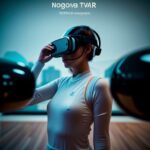
AI: The Engine of AR, VR, Gaming & Digital Twins Immersion
by AI
The convergence of Artificial Intelligence with immersive technologies like Augmented Reality (AR), Virtual Reality (VR), gaming, and digital twins is reshaping how we interact with digital and physical worlds. AI isn’t just a tool; it’s the engine driving unparalleled realism, adaptive environments, and deeply personalized experiences. This article explores how AI unlocks the full potential of these revolutionary immersive realms, creating richer, more intelligent interactions.
AI-Powered Realism and Responsiveness in AR, VR, and Gaming
Artificial intelligence is rapidly transforming the landscape of interactive entertainment and virtual environments, making experiences more believable and engaging. In gaming, AI empowers Non-Player Characters (NPCs) with sophisticated behaviors, allowing them to adapt to player actions, learn strategies, and engage in dynamic dialogues that feel genuinely responsive rather than scripted. This extends beyond mere pathfinding; AI-driven NPCs can exhibit emotions, form relationships, and even evolve their personalities based on interactions, crafting deeply personalized narratives that respond organically to player choices.
For Augmented Reality (AR) and Virtual Reality (VR), AI’s impact is profound. AI algorithms enhance spatial understanding, enabling AR applications to accurately map real-world environments and seamlessly place virtual objects within them, maintaining persistence and realistic occlusion. In VR, AI contributes to creating truly dynamic worlds. This includes:
Procedural Content Generation: AI can generate vast, intricate landscapes, cities, and dungeons in real-time or as needed, offering endless exploration possibilities without relying solely on manually crafted assets. This dramatically reduces development time and increases replayability.
Adaptive Difficulty and Personalization: Machine learning models analyze user performance, emotional state (via biometric data), and preferences, dynamically adjusting game difficulty, content presentation, or even the emotional tone of a VR experience to maintain optimal engagement and challenge.
Realistic Physics and Interactions: AI-driven simulations provide highly realistic physics, making virtual objects behave authentically in response to user input or environmental factors. Furthermore, advanced AI facilitates natural language processing for intuitive voice commands and sophisticated gesture recognition, enabling natural, unencumbered interaction with virtual interfaces and characters.
The result is not just stunning visual fidelity but a deeper level of immersion where the digital world intelligently reacts to and anticipates user actions, blurring the lines between perception and reality.
Digital Twins: AI as the Brain of the Virtual Mirror
Beyond entertainment, AI is the cornerstone of digital twins – virtual replicas of physical assets, processes, or even entire systems. These sophisticated models are not static; they are live, dynamic representations synchronized with their real-world counterparts through continuous, real-time data feeds from sensors. AI takes this concept to a new level by providing the intelligence needed to interpret, analyze, and act upon this vast influx of information, transforming data into actionable insights.
In a digital twin, AI algorithms perform several critical functions, making these virtual mirrors truly powerful:
Predictive Analytics: By analyzing historical and real-time operational data, AI can identify patterns and predict potential failures, maintenance needs, or performance bottlenecks in the physical asset before they occur. This is invaluable in sectors like manufacturing for foreseeing machinery breakdowns or in smart cities for optimizing traffic flow and predicting congestion.
Anomaly Detection: Machine learning models continuously monitor the twin’s data streams, quickly identifying unusual patterns or deviations from normal operating parameters. This proactive detection can signal a critical problem or highlight an unforeseen opportunity for improvement in the physical system.
Optimization and Simulation: AI allows for running complex “what-if” simulations within the digital twin environment, testing different operational scenarios, process changes, or design modifications without impacting the physical asset. This enables optimizing efficiency, energy consumption, material usage, or production yields in a risk-free virtual space.
Real-time Decision Support: AI processes and contextualizes data from the physical asset, offering actionable insights and recommendations to operators or automated systems, leading to more informed, efficient, and often autonomous decision-making.
Crucially, immersive technologies like AR and VR provide the interface for interacting with these AI-powered digital twins. Engineers can use AR overlays to visualize real-time data on a physical machine or step into a VR environment to walk through a virtual factory or an entire smart city model, making complex data intuitive, accessible, and highly interactive. This symbiotic relationship between AI, digital twins, and immersive interfaces creates an unprecedented tool for monitoring, managing, and optimizing our physical world.
AI is fundamentally redefining immersive experiences. From crafting intelligent, adaptive worlds in AR/VR and gaming to empowering real-time predictive analysis within digital twins, AI is the vital intelligence driving transformation. It enables unprecedented realism, personalization, and operational insight. As these technologies converge, AI promises to unlock even more sophisticated, intuitive, and seamlessly integrated digital realities, profoundly changing how we perceive and interact with our world.